

Views: 0 Author: Site Editor Publish Time: 2026-04-27 Origin: Site


Choosing a vertical turbine pump is not something that should be treated as a routine equipment replacement. It is a major decision that can directly affect system reliability, operating stability, and long-term maintenance demands. An unsuitable specification can lead to cavitation, early component damage, and unnecessary energy consumption throughout the service life of the unit.
Designing a dependable pumping system calls for careful analysis. Engineers must assess performance curves, Net Positive Suction Head requirements, and drive arrangements with precision. Even a small error in hydraulic selection can reduce efficiency, create vibration issues, and disrupt overall plant performance.
To reduce these risks, it is important to use a practical and objective selection framework. This guide explains how to review hydraulic needs, compare mechanical configurations, and make sound purchasing decisions. By following these steps, you can improve system reliability and support stable long-term operation.
Hydraulic Accuracy: Always review the Required Net Positive Suction Head (NPSHr) and maintain a 2–5 ft margin to help prevent cavitation.
Configuration Selection: The choice between a vertical lineshaft model and a submersible deep well turbine pump depends on factors such as well alignment, motor cooling, and service accessibility.
Motor Capacity: Because these pumps often operate on steep performance curves, the motor should be selected based on the highest possible load along the curve, not only the rated duty point.
Procurement Control: Requiring one manufacturer to provide the motor, pump, and controls helps avoid responsibility disputes if performance issues occur.
Before comparing products from different manufacturers, you should first define your actual system needs. Incomplete or inaccurate data at this stage often leads to poor equipment selection later. The following steps will help establish a clear hydraulic basis.
Start by identifying the main design conditions. This includes the required flow rate (GPM), Total Dynamic Head (TDH), and the properties of the liquid, such as specific gravity and viscosity.
You should also review the pump’s performance curve carefully. Vertical turbine pumps typically have relatively steep curves. This can help with stable flow control, but it also means the pump may react strongly to pressure changes. If the system curve is not plotted accurately, even a modest rise in head can significantly reduce flow.
Cavitation can quickly damage impellers and reduce pump efficiency. To avoid it, close attention must be given to Net Positive Suction Head. Begin by calculating the Available Net Positive Suction Head (NPSHa) in your system, which reflects the pressure available at the pump suction.
Then compare that value with the pump’s Required Net Positive Suction Head (NPSHr).
General Guideline: Keep a safety margin of around 20% to 35% above the NPSHr.
Practical Recommendation: Aim for NPSHa to be at least 2 to 5 feet higher than NPSHr to reduce the chance of cavitation during changing operating conditions.
Friction losses in the discharge column are sometimes underestimated. As the liquid moves upward through the pipe, friction reduces the available energy in the system. Column diameter should therefore be selected with care. In many cases, it is good practice to keep friction loss below 5 feet per 100 feet of pipe length. A slightly larger column may improve overall operating efficiency over time.
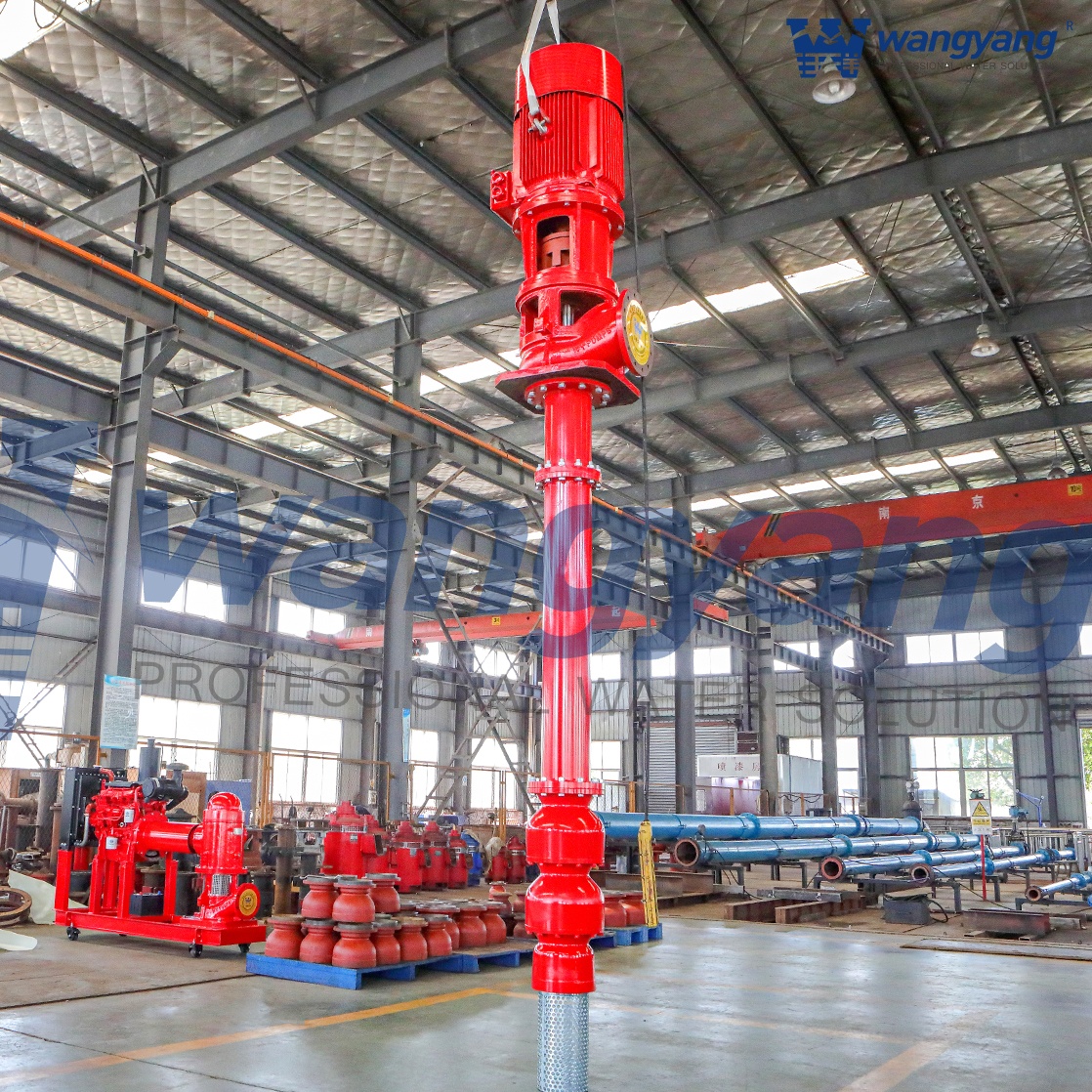
The shape of the well and the site conditions play a major role in determining the right pump arrangement. In most cases, the choice comes down to a vertical lineshaft turbine (VLST) or a submersible deep well turbine pump. Each design has its own advantages depending on the application.
In a lineshaft design, the motor stays above ground while the bowl assembly remains below the water level. A long shaft connects the motor to the pump.
Suitable for: High-flow duties, very straight wells, and applications where surface-level motor access is preferred for maintenance.
Cooling characteristics: Because the motor is mounted above ground, it is cooled by ambient air. This simplifies motor cooling compared with submerged designs and is often advantageous in top-feed well arrangements.
In a submersible arrangement, the motor is installed directly below the pump bowl assembly and the entire unit operates underwater.
Suitable for: Wells with slight bends or misalignment, installations with limited surface space, or locations where the water level is very deep.
Cooling characteristics: Submersible motors depend on continuous water flow around the motor housing for proper cooling. In top-feed wells, water may enter above the pump and fail to move adequately past the motor. In those cases, a flow sleeve is commonly used to guide water over the motor before it reaches the intake.
Feature | Vertical Lineshaft Turbine (VLST) | Submersible Deep Well Pump |
|---|---|---|
Well Straightness | Works best in straight wells to avoid shaft binding. | Handles minor bends or deviations more easily. |
Motor Position | Mounted on the surface for easier access. | Installed underwater and requires removal for service. |
Maintenance | Motor servicing is easier, but routine lubrication needs may be higher. | Lower day-to-day maintenance, but major service may require lifting equipment. |
Cooling Method | Air-cooled at the surface. | Requires proper water flow across the motor housing. |
Standard catalog data should not be the only basis for selection. More demanding applications often require closer attention to engineering standards, structural design, and material compatibility.
Many industrial projects require pumps to meet Hydraulic Institute (HI) or API 610 standards. It is important to understand which category applies to your system. For example, VS1 refers to suspended mixed-flow designs, while VS6 refers to barrel-type pumps. A VS6 design uses a suction barrel, which can remove the need for a wet pit in some installations.
Well-established manufacturers often use Computational Fluid Dynamics (CFD) to refine impeller geometry and improve internal flow conditions. They may also apply Finite Element Analysis (FEA) to verify structural strength under operating stress. These engineering methods can help improve hydraulic performance and mechanical reliability.
Pump materials should always match the characteristics of the liquid being handled. Standard clean-water applications often use bronze impellers and cast iron bowls. More aggressive fluids, such as seawater or certain industrial liquids, may require corrosion-resistant materials like duplex stainless steel or other advanced alloys.
Compliance Reminder: For municipal drinking water systems, the wetted components should meet NSF/ANSI/CAN 61 and 372 requirements. Overlooking these certifications can create major project delays.
Even a well-designed pump may perform poorly if the motor and control system are not selected correctly. Proper drive matching is essential for reliable operation.
The main operating condition should be as close as possible to the pump’s Best Efficiency Point (BEP). This is where the pump is designed to operate most smoothly. Running too far away from the BEP can create internal recirculation, vibration, bearing stress, and faster seal wear.
Important consideration: Unlike many horizontal centrifugal pumps, some vertical pump configurations may draw more power as head rises. That means selecting a motor only for the rated duty point may not be enough.
If system conditions change and demand increases, the pump may require more brake horsepower than expected. For that reason, motor sizing should be based on the highest horsepower requirement shown on the performance curve, rather than on a single operating point alone.
Variable Frequency Drives (VFDs) can reduce starting current and help the pump adapt to changing flow requirements. However, the motor must be suitable for inverter-duty operation if a VFD is used.
Application note: Running at different speeds may change the unit’s vibration behavior. It is advisable to request rotor dynamics or natural frequency analysis from the manufacturer to confirm that the pump will operate safely across the intended speed range.
Purchasing decisions can strongly influence equipment reliability, maintenance coordination, and startup success. A low initial price does not always mean fewer problems later if support, testing, and accountability are fragmented.
It is often better to purchase the bowl assembly, lineshaft, discharge head, motor, and controls as one integrated package from a single manufacturer. This creates clearer responsibility for performance and simplifies communication if problems arise after installation.
Published catalog curves provide useful guidance, but actual performance can vary due to manufacturing tolerances. For critical applications, it is advisable to specify factory testing at full operating speed. This helps confirm head, capacity, and efficiency before shipment.
Even the right pump can underperform if the installation is poorly designed. Proper submergence must be maintained according to the manufacturer’s guidance. If the water level is too low, surface vortices may form and pull air into the pump, increasing the risk of cavitation.
In addition, the suction flow path should be as smooth as possible. In closed systems, flow straighteners or suction diffusers may help create a more uniform inlet condition and support longer bearing life.
Selecting the right vertical turbine pump requires more than matching a flow rate and head value. It involves balancing hydraulic performance, mechanical design, maintenance access, and installation conditions.
Before contacting manufacturers, engineers and buyers should clearly define three key parameters: target flow, Total Dynamic Head, and the desired efficiency range. Material requirements should also be identified early so that the pump configuration matches the actual service conditions. Careful review of testing requirements and supplier responsibility can further improve project confidence.
If you are preparing to finalize your pump selection, working with an experienced application engineering team can help verify sizing, evaluate operating conditions, and support reliable long-term performance.
A: No. Running dry removes the liquid lubrication needed for lineshaft bearings and other internal components. Without that lubrication, friction rises rapidly and serious damage can occur in a very short time. Proper submergence should always be confirmed before startup.
A: A vertical turbine pump is a type of centrifugal pump, but it is arranged vertically and is typically designed for deep well or wet pit service. It often uses multiple stages to generate higher pressure and is intended to operate with the bowl assembly submerged in the liquid source.
A: The most important steps are maintaining the required submergence depth and designing the intake area to promote stable, even flow into the pump. Proper spacing, sump design, and flow-control features such as baffles can all help reduce vortex formation.

