

Views: 0 Author: Site Editor Publish Time: 2026-04-21 Origin: Site


Facility managers and engineering teams often face an important decision when selecting industrial pumping equipment. The right choice can support stable operation for many years, while the wrong one may create recurring problems such as cavitation, suction limitations, difficult maintenance, or poor fit with the installation environment. To choose correctly, it is essential to understand how a vertical turbine pump compares with a standard centrifugal pump.
This comparison is not about two completely unrelated pump technologies. A vertical turbine pump is actually a specialized form of centrifugal pump. The real difference lies in configuration, installation method, application depth, and maintenance approach. In the sections below, we explain where each design is used and how their structures affect performance and system layout.
Pump Family: A vertical turbine pump is a type of centrifugal pump, not a separate pumping principle.
Application Depth: Standard centrifugal pumps are commonly used for shallow or surface-level transfer, while deep well turbine pumps are designed for much deeper settings.
Space Requirements: Horizontal centrifugal pumps need more floor space, while vertical turbine pumps save footprint but require more headroom for installation and maintenance.
Maintenance Difference: Standard centrifugal pumps are generally easier to access and service, while vertical turbine pumps often require lifting equipment and more installation precision.
A common misunderstanding is that a vertical turbine pump and a centrifugal pump work on completely different principles. In fact, they both use centrifugal force generated by a rotating impeller to move fluid. The term “centrifugal pump” is a broad category that includes many designs, and the vertical turbine pump belongs within that category.
What makes the vertical turbine pump different is its structure. It is typically a multi-stage, vertically arranged pump with submerged bowl assemblies. By contrast, when people refer to a “centrifugal pump” in everyday industrial use, they often mean a more standard horizontal centrifugal pump with a single casing and a more compact shaft arrangement.
It is also important not to confuse a vertical turbine pump with a regenerative turbine pump. Although the names sound similar, they are different pump types designed for different operating conditions.
A standard centrifugal pump usually uses a single impeller installed inside a volute casing. As fluid leaves the impeller, the volute helps convert velocity into pressure. This design is widely used for general liquid transfer at low to moderate pressure.
A vertical turbine pump is built differently. Instead of one impeller in one casing, it uses multiple impellers stacked vertically in a series of bowls. Each stage adds pressure, so the pump can generate higher head without taking up more surface space. This staged structure is especially useful when fluid must be lifted from a deep source.
A standard horizontal centrifugal pump usually has a short shaft with bearings that are relatively easy to access. This makes routine maintenance, lubrication, and inspection more convenient.
A vertical turbine pump uses a long vertical shaft to connect the above-ground driver to the submerged hydraulic section. Because of this structure, alignment becomes far more important. If the shaft is not installed correctly, vibration and bearing wear can increase quickly. Depending on the design, the shaft may be supported by water-lubricated or enclosed bearings inside the column assembly.
Standard Centrifugal Pump: Short horizontal shaft, accessible bearing arrangement, simpler overall structure.
Vertical Turbine Pump: Long vertical shaft, submerged hydraulic section, more demanding alignment requirements.
Important Note: Proper alignment is essential for both pump types, but the consequences of poor plumbness are especially serious in vertical turbine installations.
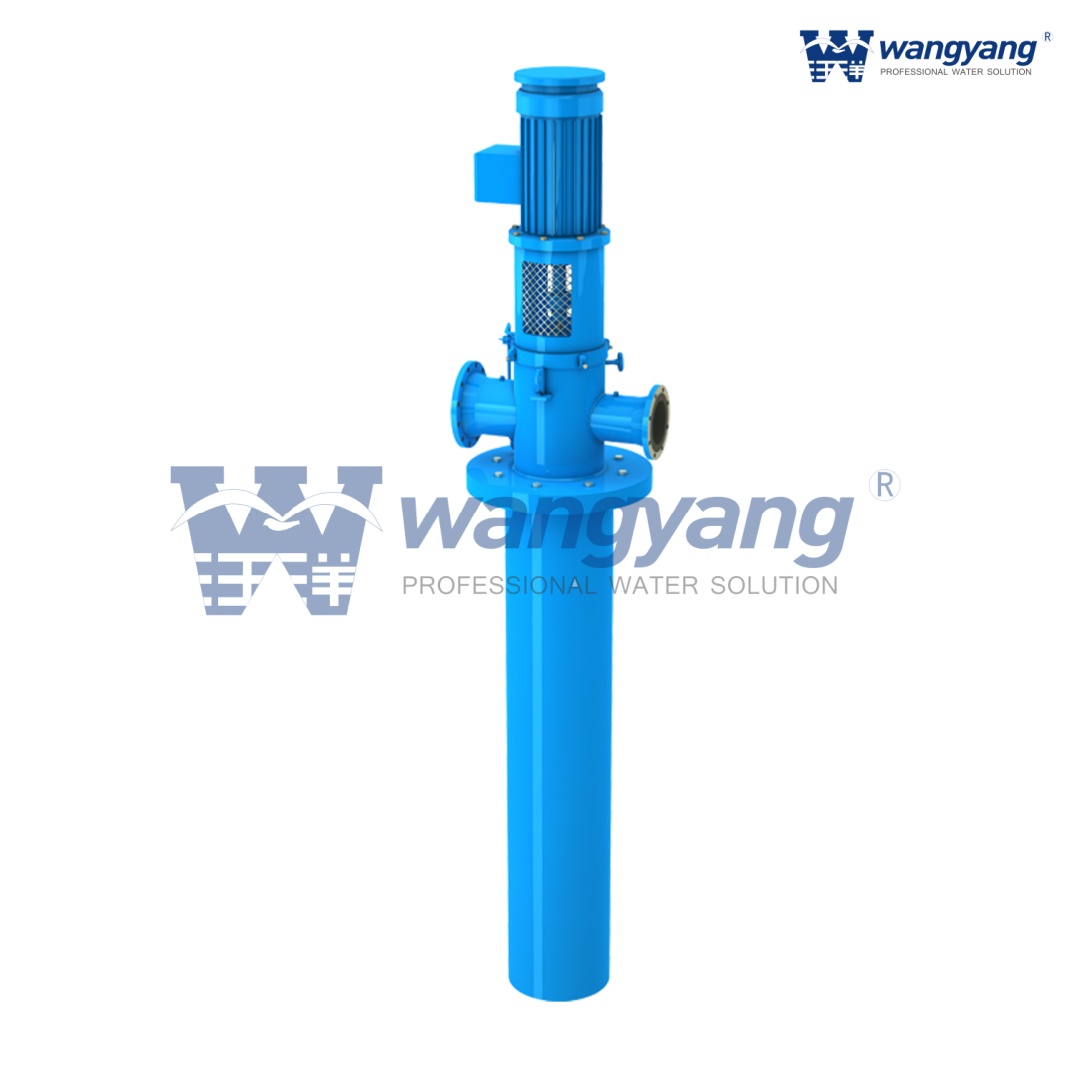
One of the biggest differences between the two pump types is how they handle suction conditions. Standard horizontal centrifugal pumps often depend on suction lift or flooded suction, and their performance can be affected if the Net Positive Suction Head available (NPSHa) is too low. If suction conditions are poor, cavitation may occur.
A vertical turbine pump reduces this issue by placing the bowl assembly and impellers below the liquid level. Because the hydraulic section is already submerged, the pump is naturally in a flooded condition. This helps improve suction performance and reduces the need for separate priming arrangements.
Standard centrifugal pumps are commonly used where the liquid source is close to the pump elevation, such as surface tanks, transfer systems, and shallow water applications. They are very effective in these settings when suction conditions are stable.
For deeper sources, the situation changes. A deep well turbine pump is designed to lift fluid from much greater depths. In these applications, a vertical turbine arrangement is often the practical solution because it pushes the liquid upward from below rather than trying to pull it from above.
Shallow Surface Service: Standard centrifugal pumps are commonly suitable for tanks, cooling systems, and general transfer duties.
Moderate Suction Conditions: Standard pumps may still be used, but NPSH and priming requirements need close attention.
Deep Source Applications: Vertical turbine pumps are more suitable when liquid must be lifted from significant depths.
Pump Type | Typical Suction Condition | Priming Requirement | Typical Application |
|---|---|---|---|
Standard Centrifugal | Shallow or surface-level suction | May require priming | Surface transfer, cooling systems, shallow tanks |
Vertical Turbine Pump | Submerged bowl assembly | Normally no priming required | Deep wells, sumps, high-head lifting applications |
A standard horizontal centrifugal pump usually needs more floor area because the pump and motor are mounted side by side. However, it generally requires less overhead space, which can make it easier to install in low-roof equipment rooms.
A vertical turbine pump takes up less floor space because of its upright arrangement. This is a major advantage in installations where footprint is limited. At the same time, it often requires much more vertical clearance because the pump may need to be lifted upward for maintenance or removal. For large units, overhead crane access may also be necessary.
In some pump stations, equipment must operate in areas where flooding is a concern. Standard centrifugal pumps may be placed in pits or low-level rooms to improve suction conditions, but this can expose motors and controls to water damage if drainage fails.
A vertical turbine pump can offer an advantage here because the motor is usually mounted above the fluid source and above potential flood level, while only the wet-end components remain submerged.
Standard horizontal centrifugal pumps are often easier to maintain. In many designs, the casing can be opened and internal parts can be inspected without fully removing the pump from the piping system. Bearings, seals, and impellers are generally more accessible at ground level.
Vertical turbine pumps can require more effort during maintenance, especially when work is needed on the bowl assembly or line shaft. In many cases, technicians must disconnect the driver and lift out the shaft, column, and bowl sections. This makes service work more complex and may increase downtime compared with standard horizontal pumps.
Factor | Standard Centrifugal | Vertical Turbine |
|---|---|---|
Installation Difficulty | Generally simpler | Requires careful vertical alignment |
Routine Maintenance | Easier access to internal components | More involved when extracting submerged parts |
Headroom Requirement | Low | High |
Floor Footprint | Larger | Smaller |
The main difference between a vertical turbine pump and a standard centrifugal pump is not the pumping principle, but the configuration and the type of application each one is designed for. A vertical turbine pump is a centrifugal pump with a vertical multi-stage structure that is especially useful for deep sources, limited footprint installations, and applications where submerged suction is beneficial.
A standard centrifugal pump is often the better choice for shallow or surface-level service where easy maintenance, lower installation complexity, and simpler access are important. A vertical turbine pump becomes more suitable when the project involves deep water extraction, low NPSH conditions, or a need to save floor space. Choosing between the two should always be based on installation depth, hydraulic requirements, maintenance strategy, and site layout.
A: Yes. For shallow or surface-level applications, a standard centrifugal pump is often suitable. For deeper sources, a vertical turbine pump is usually more appropriate because its bowl assembly can operate below the liquid level.
A: In general, standard horizontal centrifugal pumps are easier to maintain because their major components are more accessible. Vertical turbine pumps may require lifting equipment and more disassembly when servicing submerged parts.
A: Yes. Standard centrifugal pumps can often be coupled more directly, while vertical turbine pumps may require additional drive arrangements such as a right-angle gear drive, depending on the setup.
A: In most cases, no. Because the bowl assembly is submerged in the liquid, the pump normally operates under flooded suction conditions.

